Field note
Chicken biryani protein mistakes when dividing portions
A practical guide to allocating chicken biryani across plates, accounting for bones, rice, sauce and garnishes, with a worksheet method for recipe nutrient estimates.

Part 01
of 09
01 / Field note
Start with the edible chicken on each plate
For a chicken biryani estimate, record the edible chicken and rice allocated to each plate before dividing the recipe's nutrients by its serving count. Equal shares of the pot are an assumption until the components have been measured. A plate's total weight alone does not describe its contents.
Biryani makes this distinction useful because the chicken and rice can sit in separate layers. In the SBS recipe by Fuzz Ali, marinated bone-in chicken covers the pan base, with partially cooked rice placed above it. Yoghurt, fried onions, saffron milk and ghee also enter the dish. A calculation based on that recipe needs to account for those ingredients as well as the chicken and rice.
The practical method below applies recipe-calculation principles from the Food and Agriculture Organization of the United Nations, known as FAO, and edible-weight definitions from USDA FoodData Central. It separates the work into an ingredient record, a finished-dish record and a record of each plate's components. These are calculation records, not a new biryani recipe.
Start by deciding what the estimate describes: the whole prepared dish, the food served, or the food eaten. Those quantities belong in separate parts of the worksheet. This makes it possible to follow the calculation from the ingredients through to the plate without silently changing what is being measured.
Part 02
of 09
02 / Field note
A recipe's serving count does not describe its portions
Use the stated serving count to describe the recipe, then measure how its chicken and rice are divided. The count does not supply an edible chicken weight for each plate. The SBS recipes illustrate why the ingredient list and the serving label need separate attention.
Fuzz Ali's SBS recipe specifies one kilogram of bone-in chicken and two cups of basmati rice for six people. Kirsten Jenkins's SBS recipe specifies a 1.4-kilogram whole chicken and 600 grams of basmati rice for four people. These are different starting recipes, with different ways of describing the chicken and rice quantities.
In Jenkins's recipe, the chicken is divided into legs, thighs and breast portions, and the wing tips are discarded. A record that says only that each plate received a chicken piece loses the identity of that cut and its edible weight. Record the cut alongside the weight if the nutrient reference distinguishes anatomical parts.
Measurement conventions also belong beside the ingredient quantities. Ali's recipe uses Australian measures, with a 250-millilitre cup and a 20-millilitre tablespoon. When following that recipe, retain those definitions in the worksheet rather than attaching an unrelated household measure to its quantities.
For a comparison between recipes, first put the ingredient records on a consistent basis. Identify the rice's preparation state and distinguish whole or bone-in chicken weight from edible chicken weight. Only then does the recipe record describe comparable materials; the serving count by itself cannot do that work.
Part 03
of 09
03 / Field note
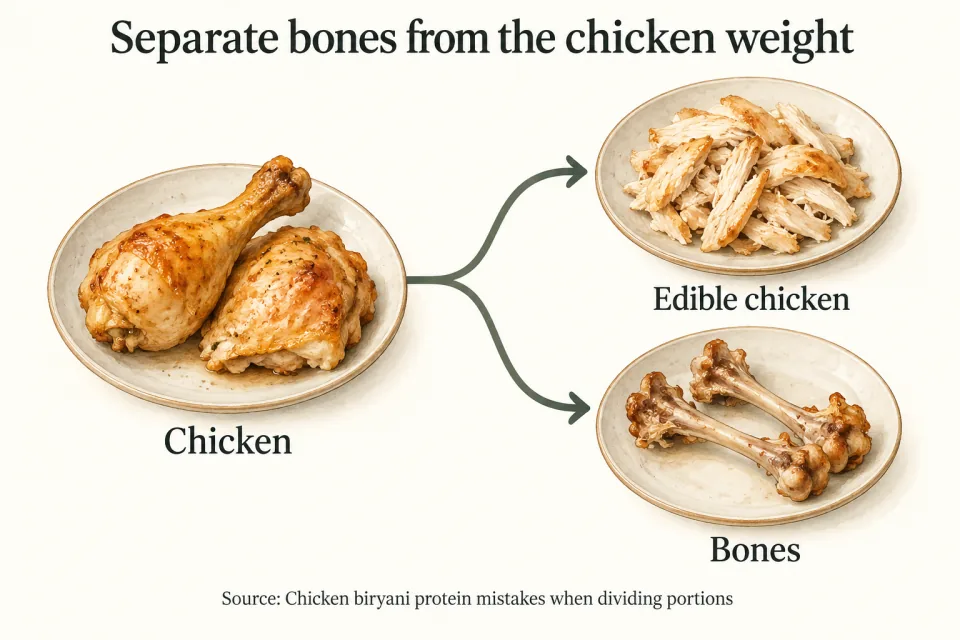
Separate bones from the chicken weight
Use edible chicken weight when matching a portion to a nutrient reference for edible chicken. USDA FoodData Central defines portion weights as edible material and illustrates this with a chicken leg without its bone. The bone therefore belongs outside the weight used for that edible portion.
For a worksheet based on cooked chicken, remove the bones before weighing the edible chicken assigned to a plate. Record the bones separately if you are also reconciling the weight of the bone-in pieces. This follows the distinction between edible and discarded material in FAO's sample-preparation method.
Skin needs an explicit description too. If it is included in the food being measured, describe the edible portion accordingly and match the reference to that material. If it is discarded, place its weight with the discarded material. The aim is to make the food on the scale correspond to the food named in the composition record.
Use measured discarded material for the pieces in the dish. A fixed deduction would be an additional assumption, whereas weighing separates the edible and discarded quantities directly. Label a bone-in weight as bone-in throughout the record so it cannot later be mistaken for the edible amount.
For serving chicken on the bone, record the plated pieces and then separately record the edible material and discards when assessing what was eaten. That produces a different record from weighing deboned chicken before serving. Choose the approach that matches the question, and retain the distinction in the worksheet.
Part 04
of 09
04 / Field note
Match the reference to the cooking stage
Match each ingredient's measured weight to a composition record for the same preparation state and material. FAO's food-description work distinguishes uncooked and cooked food, cooking method and anatomical part. These details identify what a nutrient value describes.
For chicken, write down the cut, whether the measured material includes skin, and whether the weight was taken before or after cooking. For rice, identify whether the recorded quantity is dry rice, partially cooked and drained rice, or rice in the finished dish. Those descriptions prevent unlike measurements from entering the same column unnoticed.
FAO's recipe-calculation procedure distinguishes a route using cooked ingredient data from a route using uncooked ingredient data. With cooked data, the procedure converts starting ingredient weights to cooked weights using yield factors. With uncooked data, it accounts for cooking through weight-yield adjustments and nutrient-retention factors.
Yield and retention describe different things. In the EuroFIR report hosted by FAO, yield concerns the food weight retained, while retention concerns the nutrients retained. A weight change alone therefore does not supply the nutrient adjustment needed by a recipe calculation.
This distinction matters for the rice preparation in Ali's recipe, which involves partial boiling and draining before layering. FAO describes changes in water and solids during boiling and draining, and changes in water and fat during frying. Write down the preparation method before selecting the calculation route, so the worksheet follows the recipe's actual sequence.
Part 05
of 09
05 / Field note
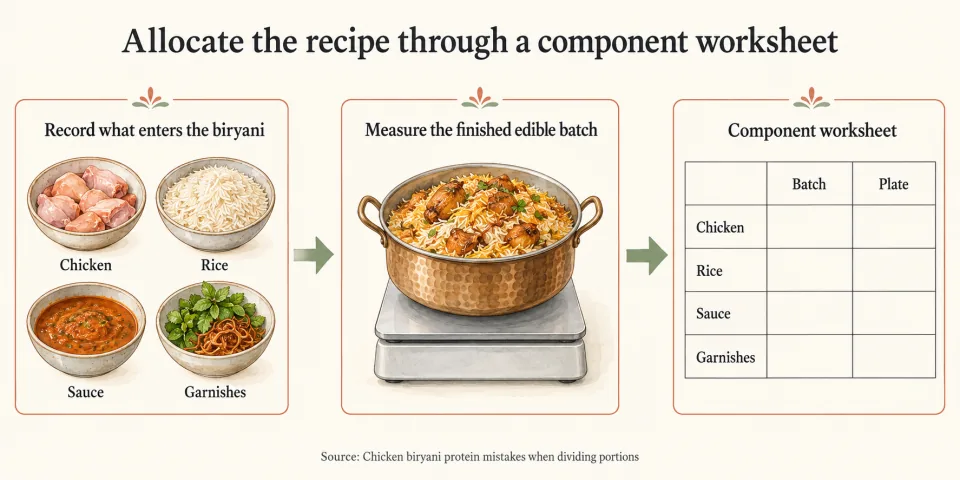
Record what enters the biryani
Build the ingredient record around the quantities that enter the dish, including additions between layers and on top. FAO's recipe procedure collects ingredient weights and nutrient data, then accounts for preparation losses. A transcription of the initial ingredient list is only the starting record.
Give each ingredient a description, preparation state, measured quantity and matching nutrient reference. Add a place for discarded material and a place for the quantity added to the pan. These entries make the calculation traceable when preparation changes an ingredient's weight before assembly.
Jenkins's recipe allows excess marinade to drip from the chicken before it enters the pan. Its fried onions and almonds are drained on paper towels before distribution through the dish and over the top. The worksheet should distinguish the starting quantities from the prepared quantities added at those stages.
Ali's assembly adds saffron milk, ghee and fried onions between rice layers. Give those additions their own entries rather than placing them under an undefined allowance for sauce. Record yoghurt with the other ingredients as well, so the recipe calculation follows the named components.
The EuroFIR procedure describes detailed preparation records or weighing prepared ingredients immediately before addition. Either approach connects the ingredient list to the assembled dish. Include material remaining on utensils and preparation vessels in the accounting, as FAO's recipe procedure does, so it is not automatically assigned to the finished food.
Part 06
of 09
06 / Field note
Measure the finished edible batch
Use the finished edible batch weight as the basis for a whole-dish concentration estimate. FAO's recipe procedure combines the ingredient nutrient contributions and relates the result to the cooked dish weight. The starting ingredient weight and the finished weight have different roles.
Weigh the empty serving vessel separately from the food, then record the finished food weight without the vessel. Identify whether that measurement includes bones or other discarded material. For an edible-batch calculation, use an edible-batch weight, with excluded material recorded separately.
A whole-batch estimate describes the recipe averaged across its edible contents. Applying that average to a plate assumes that the plate represents the batch's mixture. FAO's laboratory preparation method thoroughly incorporates the components of mixed dishes before analytical portions are taken; a plated layered biryani calls for attention to how its components were distributed.
For a component record, measure the chicken separately from the rice mixture and identify any separately served sauce or garnish. EuroFIR provides separate edible-yield calculations for a whole dish, its solids and its gravy. This supports distinguishing components in the worksheet instead of leaving their weights hidden within the batch total.
Describe the boundaries clearly. If onions and sauce remain with the rice, label that component as the rice mixture. If a garnish is weighed and allocated separately, give it a separate entry. Each ingredient should have a defined place in the calculation so the same addition is not counted again under another component.
Part 07
of 09
07 / Field note
Allocate the recipe through a component worksheet
Allocate the calculated recipe nutrients according to measured component shares, with the assumptions written beside them. This is an application of the supplied recipe methods to a layered dish. It gives the chicken, rice mixture and separately served additions their own allocation records.
Begin with the ingredient calculation. For each ingredient, combine its edible weight with the matching nutrient reference, using consistent weight units and the chosen cooking adjustments. Add the contributions to obtain the recipe totals, following FAO's procedure. USDA FoodData Central's documentation supplies the general conversion from a reference concentration to a weighed edible portion.
Next, connect each ingredient contribution to the component in which you have recorded it. Chicken belongs in the chicken allocation; rice and additions assigned to the rice mixture belong in that allocation. State where yoghurt, ghee, onions and other additions are being assigned. This is part of the calculation model and should remain visible.
For each plate, divide its edible chicken weight by the edible chicken weight of the batch. Apply that share to the calculated chicken contribution. Repeat the process using the plate's rice-mixture weight and the batch's rice-mixture weight. Allocate separately measured garnishes using their own recorded quantities.
This procedure assumes that the nutrient contribution assigned to each component is distributed in proportion to its edible weight. If different chicken cuts have separate composition references, retain separate cut records instead of treating all the chicken as identical. If sauce or toppings are distributed separately, describe that allocation separately too.
Finally, reconcile the records. The components assigned to served plates, plus the edible food still in the serving vessel, should account for the measured edible batch. Investigate a mismatch by checking the vessel weight, bones, discarded material and component entries. The resulting worksheet shows both the arithmetic and the assumptions behind it.
Part 08
of 09
08 / Field note
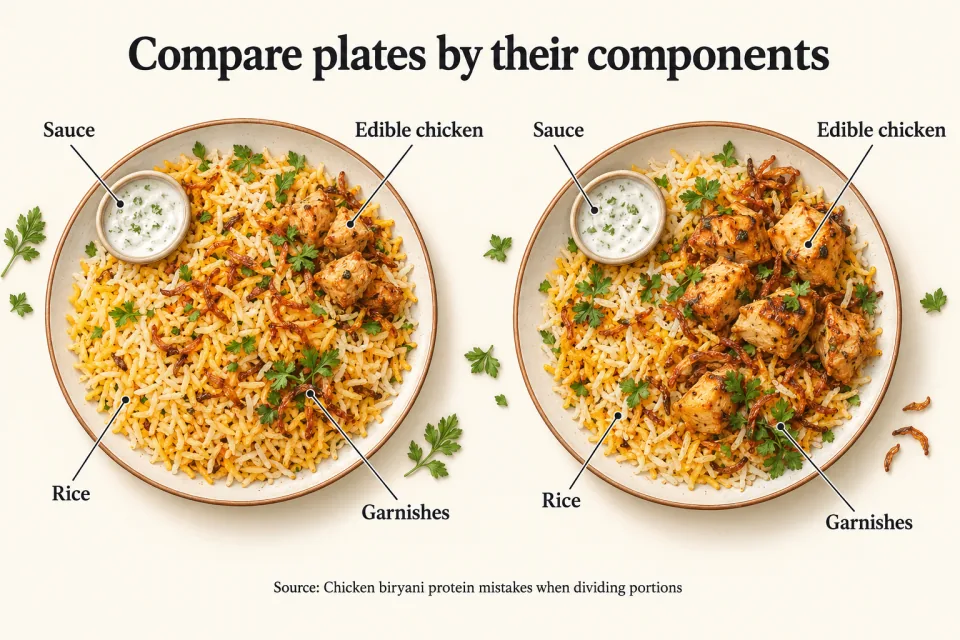
Compare plates by their components
Equal total plate weights can conceal different allocations of chicken and rice. To compare plates, read the component entries before using a whole-dish average. This is where the worksheet changes the interpretation of an apparently equal serving.
Consider a comparison in which the total food weights match but the recorded edible chicken weights differ. The rice mixture or other components account for the balance of the weight. Under the component method, the chicken allocation follows the measured chicken share, while the rice-mixture allocation follows its own share. The common total weight does not replace those measurements.
Now consider plates with matching edible chicken weights but different rice-mixture quantities. Their chicken allocations match only under the same chicken-reference assumptions, including the cut and material described. Their rice-mixture allocations remain different. Record both parts instead of using the matching chicken weight as a description of the entire plate.
Bone-in pieces introduce another comparison. A plate weighed with its bones and a plate weighed after bone removal are recorded on different bases. Put both on an edible-material basis before comparing their component weights, following the edible-portion definition used by USDA FoodData Central.
Sauce and garnish need the same attention. Jenkins's recipe distributes fried onions and almonds through the dish and over its top, while Ali's recipe adds ingredients between rice layers. When allocating these additions, state whether they are assumed to follow the rice mixture or are measured separately. That makes the comparison depend on a stated method rather than the appearance of the plates.
Part 09
of 09
09 / Field note
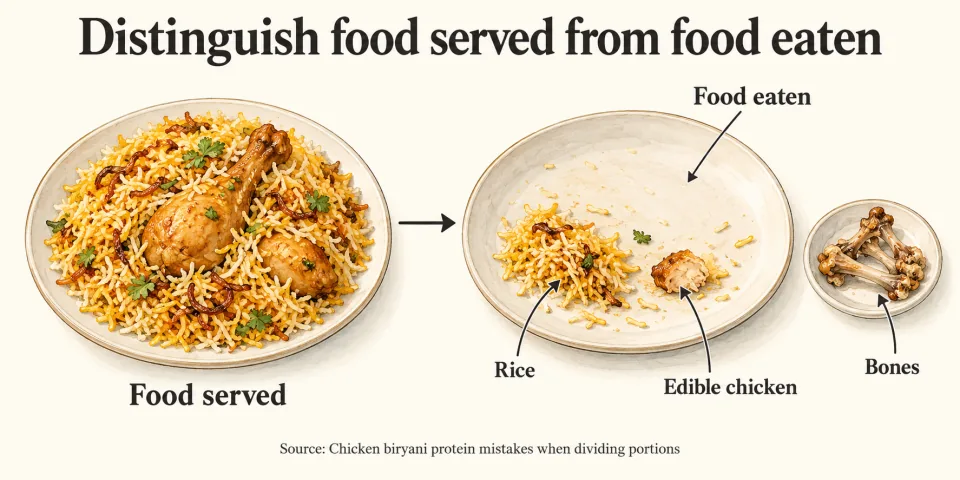
Distinguish food served from food eaten
An estimate of food eaten needs a consumption record as well as a serving record. The FAO/WHO Global Individual Food Consumption Data Tool describes recording quantities prepared and consumed, including records at ingredient level. This allows the final calculation to follow the edible components consumed.
Record the served chicken, rice mixture and separate additions in their existing categories. Then record any edible chicken, rice or sauce that remains uneaten in those same categories. Bones and other discarded material stay outside the edible consumption amounts.
For the chicken entry, distinguish meat still attached to a bone from the bone itself. For the rice-mixture entry, use the amount eaten rather than automatically assigning everything originally served. EuroFIR also identifies discarded whole spices and unconsumed gravy as considerations in prepared-dish calculations.
Retain the recipe description, ingredient references, cooking adjustments and allocation assumptions alongside the consumption record. FAO notes that natural variation in foods can persist even after composition data have passed quality checks. The calculation is therefore an estimate tied to a defined recipe and method.
For the next biryani calculation, the useful record is the complete path: ingredients entering the pan, finished edible components, portions served and components eaten. That record lets the serving count remain a recipe description while the measured food determines the allocation.
Sources / 09
- Foundation Foods Documentation
- Calculation of the composition of dishes prepared from recipes
- Quality considerations in the compilation of a food composition database
- Food Composition Data: Selection of foods
- Methods of preparation of foods for analysis
- Data collation, harmonisation and sharing
- Hyderabadi biryani (layered chicken and rice dum biryani)
- Hyderabadi-style chicken biryani
- Report on collection of rules on use of recipe calculation procedures including the use of yield and retention factors for imputing nutrient values for composite foods
Continue reading
Return to the card board