Field note
How to make high protein french toast and measure batter uptake
Choose bread, compare egg and milk ratios, and follow a pan method. Learn how to account for the batter that reaches the finished toast when estimating protein.
Part 01
of 09
01 / Field note
Start with a measured egg and milk batter
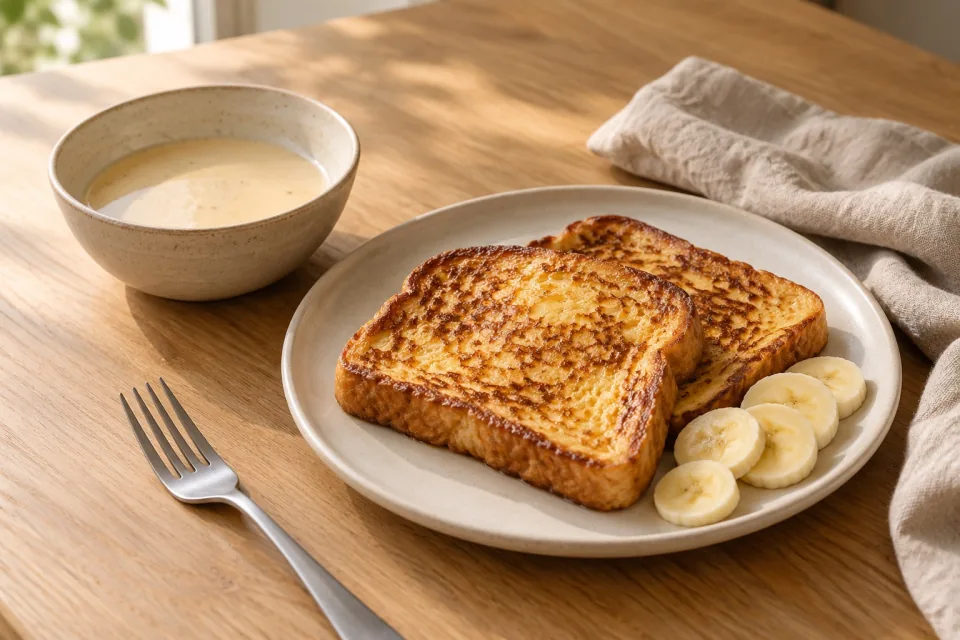
To make french toast with protein in mind, measure the ingredients and account for the batter that reaches the finished toast. The egg and milk mixed in the bowl provide the starting record for a recipe estimate. Batter remaining outside the dish needs its own accounting.
Oregon State University's Food Hero recipe combines two eggs with half a cup of low-fat or nonfat milk for four slices of whole-wheat bread. Beat the eggs and milk together until evenly combined, using a dish wide enough to dip the bread. Follow this combination as a complete pan recipe before choosing among the different preparations below.
Food Hero specifies about two minutes of cooking per side in a lightly greased skillet over medium heat, until the toast is browned and cooked through. Use a spatula to turn the bread, checking those endpoints as you cook. For a written recipe record, note the bread used and the ingredient amounts before dipping, then record the batter remaining afterward.
Part 02
of 09
02 / Field note
Choose bread by thickness and condition
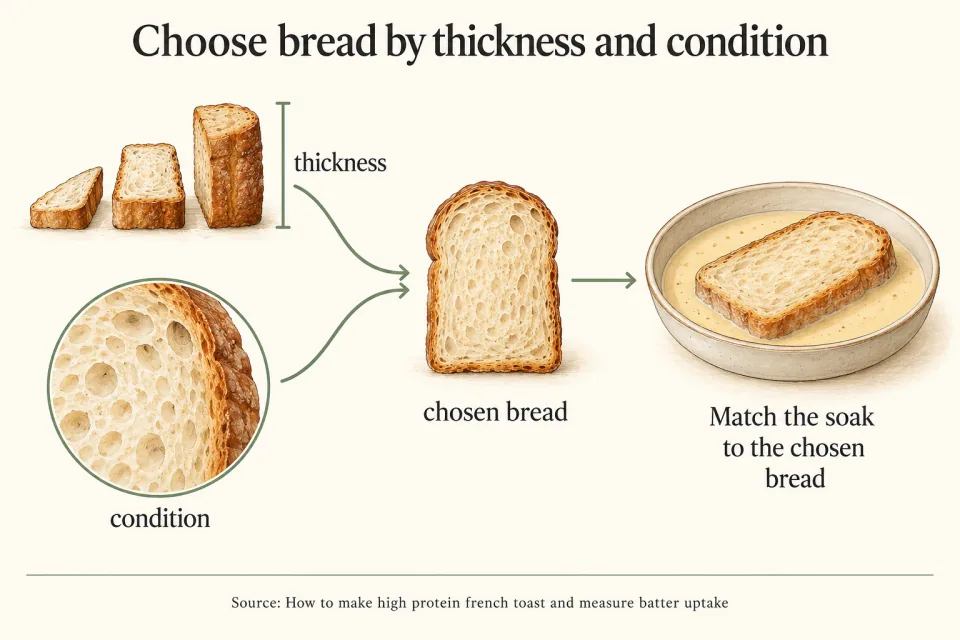
Choose bread with attention to its thickness and its condition before soaking. Serious Eats found that oven-dried soft sandwich bread held its shape after soaking better than fresh soft sandwich bread. That finding gives a specific reason to consider dried sandwich bread when handling soaked slices.
Crusty bread behaved differently in the same publication's tests. Fully stale crusty loaves absorbed custard less readily than fresh or slightly stale loaves. Read these findings with the bread type attached: oven-dried soft sandwich bread and fully stale crusty bread were different cases in the comparison.
For unstuffed french toast, Epicurious recommends bread cut about three-quarters of an inch thick. Use that thickness when following its approach, and include thickness in any notes about the batch. A record that says only sandwich bread or brioche leaves out a detail that the cooking guide specifically addresses.
The researched recipes also pair different breads with different mixtures. Food Hero uses whole-wheat bread with eggs and milk, while Good Food Middle East pairs thick brioche with eggs, milk and cream. Comparing the finished dishes therefore compares several recipe choices together. To examine bread choice separately in your own cooking notes, record its weight and thickness and leave the batter formula unchanged; describe that as your comparison rather than a result established by these sources.
Part 03
of 09
03 / Field note
Read the egg and milk ratio as part of the recipe
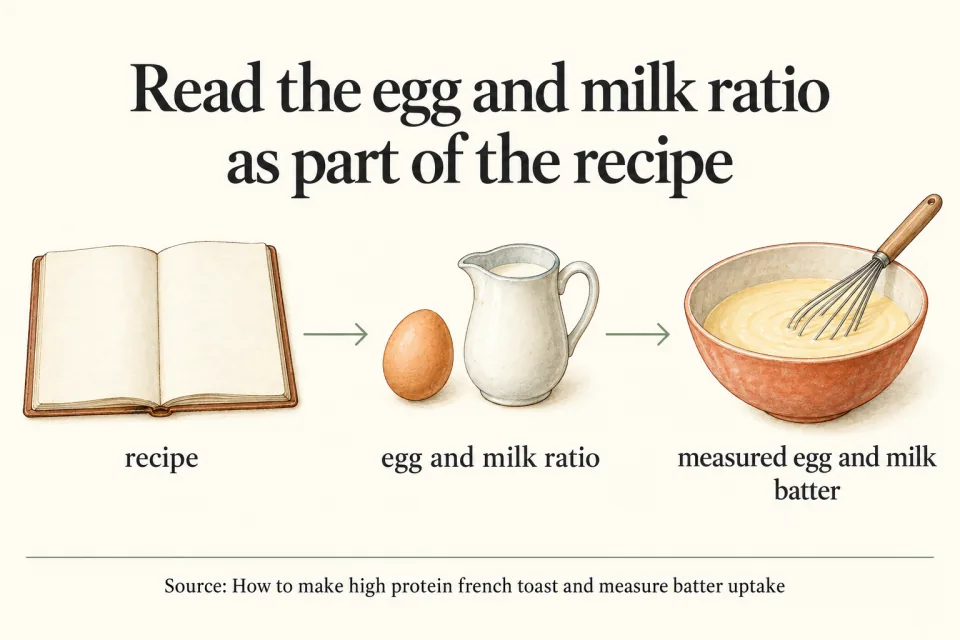
Choose the batter ratio alongside the texture and method you want to follow. In its french toast tests, Serious Eats preferred three eggs per cup of milk. Its accompanying method calls for bread soaked until saturated, so the ratio belongs with that approach to dipping.
Epicurious explains that increasing the milk makes softer toast, while using less milk gives a sturdier result. This gives milk quantity a cooking role as well as a place in the ingredient record. When deciding between published recipes, use their stated texture and method to guide the choice rather than judging them by egg count alone.
Good Food Middle East uses two large eggs, 80 ml of whole milk and 40 ml of double cream for four thick brioche slices. Follow those quantities together when making that version. Substituting its dairy mixture into a different recipe would create a variation beyond the formula supplied here.
For cooking, retain the units each recipe gives. For a weight-based recipe estimate, also weigh the ingredients as you add them and record those weights beside the cooking quantities. This connects the practical recipe to the ingredient-weight calculation described by the Food and Agriculture Organization of the United Nations, or FAO. It also makes clear which milk or cream was used, rather than grouping all dairy mixtures under the same description.
Part 04
of 09
04 / Field note
Match the soak to the chosen bread
Use the soaking instructions attached to the recipe you are making. Serious Eats describes its endpoint as saturated bread without assigning a fixed dipping time. The University of New Hampshire Extension recipe instead specifies a 15–20-second dip for each slice.
Good Food Middle East soaks its thick brioche in a single layer for two to three minutes, then turns it for another two minutes. Arrange the bread so you can turn the slices within that method. Its longer soak belongs to the brioche preparation and should be recorded with that bread and batter when describing the result.
Food Hero suggests poking holes in the bread to help it take up more egg mixture. If following that option, include it in your preparation notes alongside the bread's condition. A batch dipped with holes and a batch dipped without them have different preparation records, even if their ingredient lists are otherwise alike.
For the later weighing record, lift the bread over the dipping dish and direct drips back into that dish. Use a consistent handling sequence across the batch, and note any mixture that lands elsewhere. This makes the next measurement easier to interpret: batter returned to the bowl remains in the bowl's account, while drips caught elsewhere need a separate entry. The weighing method below explains how to use those entries.
Part 05
of 09
05 / Field note
Judge the pan result by texture and cooking endpoints
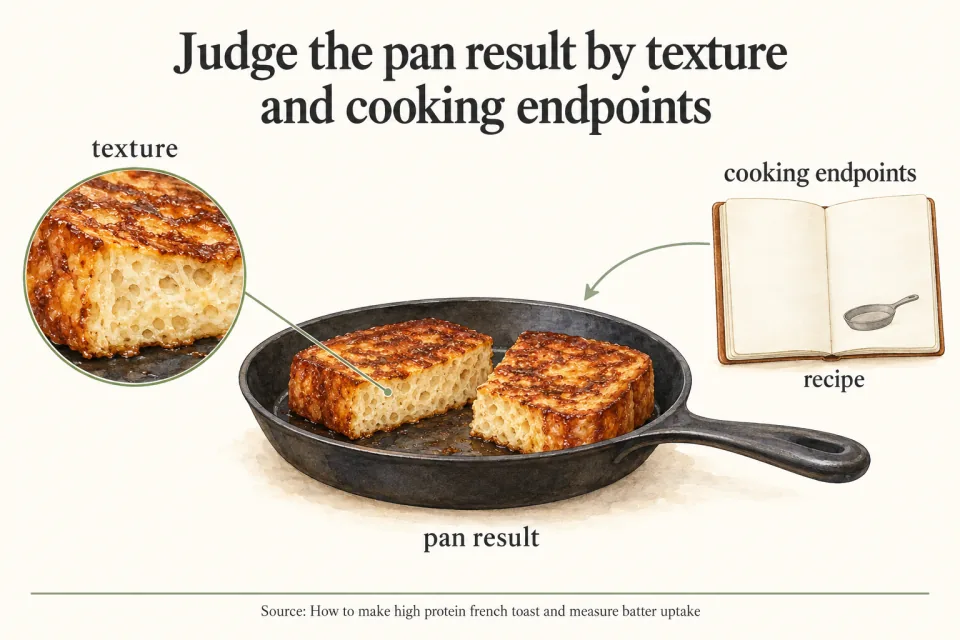
Use the recipe's stated endpoint together with its heat setting and timing. University of Illinois Extension identifies browned surfaces and firm batter as the endpoints for its banana french toast. The surface and the batter therefore each have a part in judging that version.
For its soaked brioche, Good Food Middle East cooks two slices at a time over medium heat for three minutes per side, until golden and crisp. Follow that batch arrangement when using its method. Lift and turn the slices with a spatula, then check the surface described by the recipe as the batch finishes.
The University of New Hampshire Extension method heats oil over medium-high heat and browns the toast for three to five minutes per side. This differs from the other published pan methods in both heat setting and timing. Record the complete method you used, including the bread and dip, so a later comparison has more detail than cooking time alone.
Longer cooking also changes the egg mixture's texture. The Exploratorium explains that prolonged heating toughens set egg proteins and forces liquid out, producing a rubbery result. If describing a batch with that texture, record the heat and duration alongside the soaking details. That separates the pan stage from the bread preparation in your notes, without assuming that every texture problem began in the dipping bowl.
Part 06
of 09
06 / Field note
Choose a savory custard or a banana variation
Flavor changes can follow an established variation without adding a new cooking method. Epicurious suggests black pepper or cayenne pepper in the custard for savory french toast. This is a seasoning option within its guide, so use it with that guide's bread and custard approach.
The University of Illinois Extension banana version combines a mashed ripe banana, two eggs and one-quarter cup of nonfat milk for four whole-wheat bread slices. Mash the banana as directed before combining the mixture, and describe the dish as banana french toast in your recipe record. Its batter contains an ingredient beyond the egg and milk mixture used in the basic pan recipe.
Illinois Extension lists yogurt, fruit and applesauce as optional toppings and excludes them from its published recipe nutrition calculation. If you include them in a separate estimate, give them their own ingredient entries. This makes the boundary of the calculation clear: the toast recipe and the chosen additions can be accounted for separately, without assuming that optional toppings were already included in a published figure.
Part 07
of 09
07 / Field note
Use the baked instructions for egg-white variations
The supplied egg-white variations use oven methods, with different ways of putting the mixture onto bread. University of Maine Cooperative Extension combines two egg whites, two whole eggs and half a cup of fat-free milk for eight slices of whole-wheat or firm white bread. Its method dips the bread and then pours the remaining batter over it.
That pouring step changes the ingredient accounting compared with a pan recipe that leaves mixture in the dipping dish. In the Maine preparation, the remaining mixture is deliberately added to the assembled dish. Record that addition as part of the recipe, then account separately for anything still on the preparation utensils or outside the finished food.
The Maine recipe bakes at 425°F for 15 minutes before turning the bread and baking for another 10 minutes. Use that oven sequence with its stated ingredients and assembly. It is a separate preparation from the skillet recipes, with its own directions for turning and finishing the toast.
SNAP Western offers a different bake made with yogurt and egg whites, with protein powder optional. Its method presses hollows into bread, adds the mixture and fruit, and bakes at 180°C for 15–17 minutes. Here, the mixture is placed in the hollows rather than taken up through dipping. For an ingredient record, describe that assembly explicitly and measure the filling transferred from the mixing vessel; the same accounting question applies even though there is no soaking interval.
Part 08
of 09
08 / Field note
Measure the batter transferred into the dish
Account for batter movement by measuring what starts in the preparation vessels and what remains outside the finished toast. FAO says recipe calculations must allow for ingredients remaining in preparation vessels or on utensils. The following weighing procedure applies that principle to dipped french toast.
Begin by weighing the empty dipping dish and the utensils that will be included in the readings. Weigh the same set with the mixed batter, then subtract the empty weight to obtain the starting batter weight. Mixing and dipping in the same dish gives the record a common starting vessel; if you use another vessel, include the mixture remaining there in your notes.
After dipping, weigh the dish, its remaining batter and the same utensils again. The difference between the starting and ending batter weights represents mixture removed from that measured set. Return the utensils to the weighing arrangement each time so their weight is handled consistently in the subtraction.
Account separately for mixture that left the dish without becoming part of the toast. Catch drips in a weighed dish if they are not returned to the dipping bowl, and record their weight. Subtract those drips from the amount removed from the dipping setup. Also record mixture transferred to another surface or utensil outside the measured set.
Follow that account through cooking. If batter cooks separately from the bread in the skillet, note whether it becomes part of the served dish or is excluded. The same distinction applies to mixture remaining on the pan or turning utensil. FAO's procedure includes discarded material, so the recipe account extends beyond the moment the bread leaves the bowl.
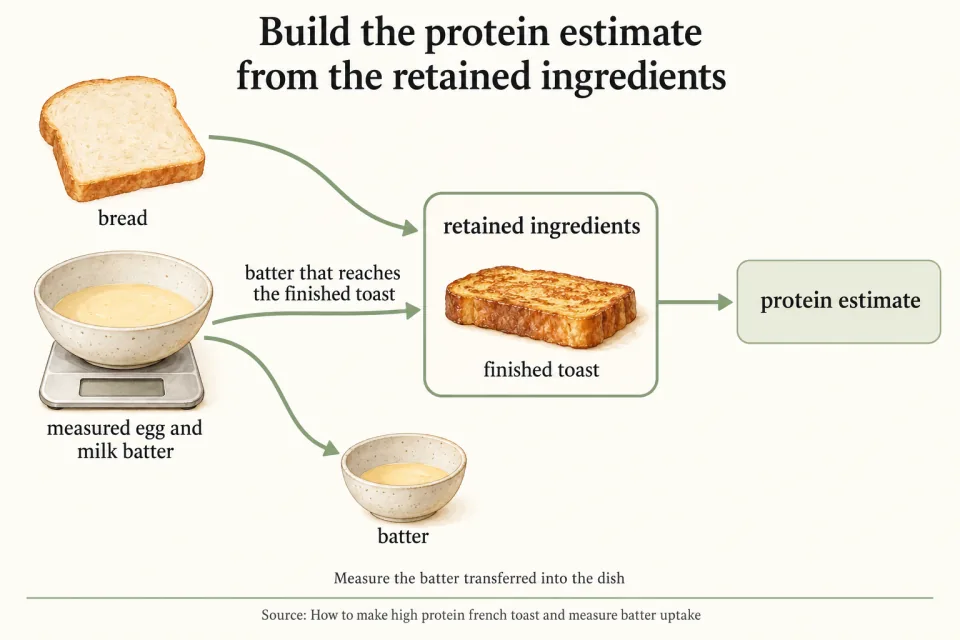
Call the result an estimate of retained batter, including mixture within the bread and its surface coating. The weighing record documents transfer and observed losses; it does not distinguish the coating from liquid absorbed into the crumb. Use that definition when describing batter uptake, so the calculation has a clear boundary.
Part 09
of 09
09 / Field note
Build the protein estimate from the retained ingredients
Build a recipe estimate from ingredient composition data and the amounts included in the dish. FAO begins its calculation procedure with ingredient weights and nutrient-composition information. The bread belongs in that record alongside the eggs and milk, with any cream, banana or other additions entered according to the recipe used.
For the batter, combine the ingredient contributions using their measured weights and protein concentrations. Relate that calculated protein contribution to the total mixed-batter weight, then apply the resulting concentration to the retained-batter amount. This calculation assumes the retained mixture has the same composition as the mixed batch. State that assumption with the method rather than presenting the weighing step as a direct measurement of protein.
Add the bread's contribution separately and make separate entries for toppings. This arrangement lets the calculation follow the dish's assembly: bread, retained batter and additions. It also lets a later change be identified precisely, such as a topping added after cooking or batter poured over bread in a baked version.
FAO's procedure calls for weighing the assembled uncooked dish and weighing it again after cooking. Its calculation method also accounts for water and fat changes, discarded material and applicable nutrient-retention factors. These records describe the finished recipe beyond the dipping stage; the batter-transfer measurement is part of that account, rather than the whole calculation.
FAO describes calculated recipe values as rough estimates because preparation conditions affect yield and nutrient retention. FAO also cautions that natural variation in foods limits how accurately composition data can predict a particular portion. Present the method with the ingredient records, retained-batter definition and included additions, so the estimate can be read alongside the preparation it describes.
Sources / 11
- Perfect Quick-and-Easy French Toast
- How to Make French Toast in 6 Easy Steps
- French Toast
- French toast
- French Toast
- French Toast Delight
- New Wave French Toast
- High Protein French Toast Recipe
- Food Composition Data: Appendix 6: Calculation of the composition of dishes prepared from recipes
- Food Composition Data: Chapter 1: Food composition data and food composition databases
- Science of Cooking: Effects of gentle versus high heat on egg proteins
Continue reading
Return to the card board