Field note
Why yogurt turns watery in cilbir and how to assemble it
Separate yogurt whey from water carried by poached eggs, choose a thick yogurt base, and follow a clear assembly sequence for garlic yogurt, eggs and pepper butter or oil.
Part 01
of 09
01 / Field note
Check when the liquid appears
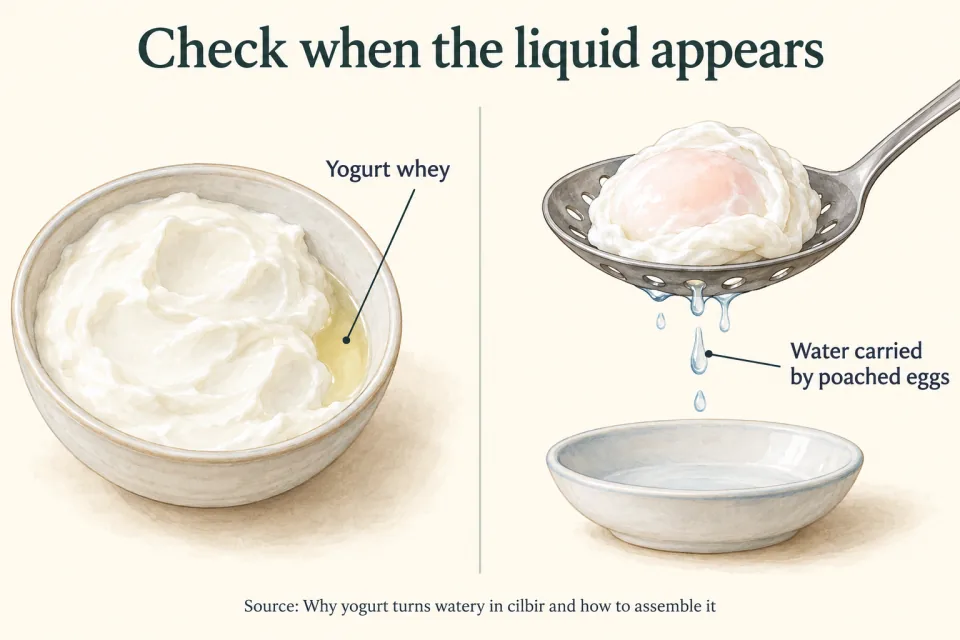
For watery cilbir, check the yogurt before assembly, the draining step after poaching and any heat applied to the yogurt. These checks separate the yogurt's own whey from the water involved in cooking the eggs.
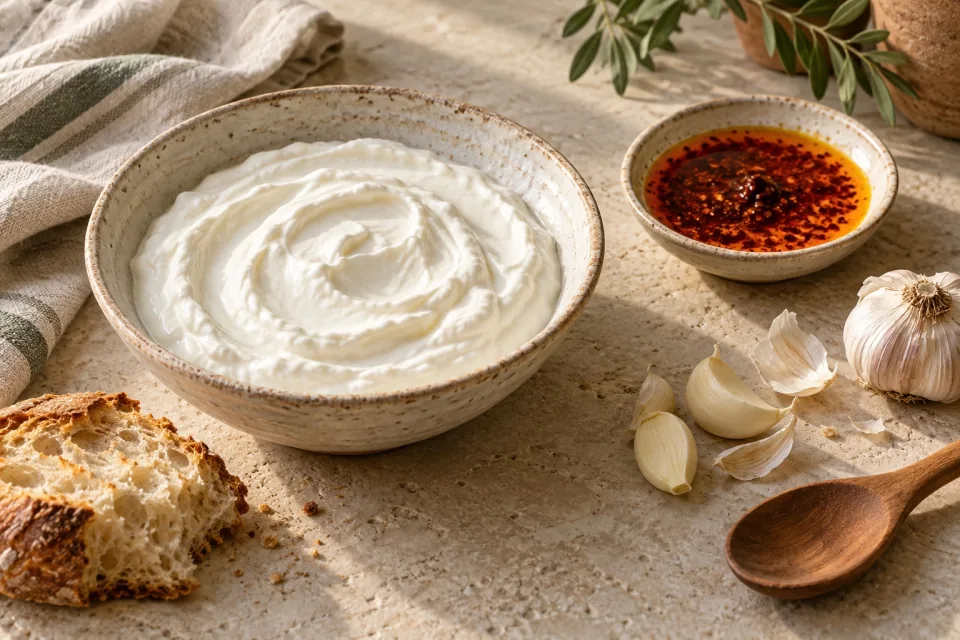
Cilbir, written çılbır in Turkish, combines poached eggs with garlic yogurt and a pepper topping made with butter or oil. The Republic of Türkiye Ministry of Culture and Tourism describes a version with drained eggs, garlic yogurt and red-pepper olive oil. Peter Gordon's version uses thick Greek yogurt and a butter topping.
Begin the check before the eggs reach the plate. Look at the plain yogurt, then at the yogurt after mixing in the garlic. If liquid is already present, examine the yogurt and its preparation before changing the poaching method. Whey can collect on yogurt naturally, as the University of Alaska Fairbanks explains.
If the yogurt looks thick until the eggs arrive, review how the cooked eggs were drained. Both the Turkish ministry's method and the American Egg Board's poaching instructions include draining before serving. Treat the point at which liquid appears as a way to organize the work, rather than as proof of its cause.
If the yogurt has been heated directly, review that step separately. University of Maine Extension cautions that yogurt is not heat stable in cooked recipes.
Part 02
of 09
02 / Field note
Why yogurt can release whey
Yogurt contains water held within a protein gel, so its firm appearance does not mean all its liquid is permanently bound. The University of Wisconsin–Madison's Center for Dairy Research describes this structure in its yogurt monograph.
During fermentation, yogurt cultures convert lactose into lactic acid. That acid causes milk proteins to form a gel. Water and dissolved substances occupy the gel's structure without becoming part of the coagulated protein itself. The watery portion includes lactose, lactic acid and milk salts.
The University of Alaska Fairbanks calls the collection of whey on yogurt's surface syneresis. Some of this separation happens naturally. For cilbir preparation, the useful distinction is between liquid already present in the yogurt and water brought over from the poaching pan. Inspecting the yogurt before seasoning makes that distinction easier to follow.
The milk's preparation also contributes to the yogurt's structure. Wisconsin's monograph explains that heating milk before fermentation changes whey proteins so they can join the gel and help it retain water. This is a yogurt-making step, separate from warming finished yogurt for a dish.
Straining works at another stage. After fermentation, it removes water and water-soluble components as whey while retaining the yogurt mass. That gives a practical route to a thicker base: separate some liquid from the finished yogurt before assembling the eggs and topping. It also explains why straining deserves its own step, rather than being folded into the final plating.
Part 03
of 09
03 / Field note
Choose the yogurt by its preparation as well as its texture
Thick Greek yogurt is the starting point in Peter Gordon's cilbir recipe. For a loose yogurt base, straining is a separate preparation option supported by the yogurt sources.
Harvard's Nutrition Source describes strained yogurt as thicker than unstrained yogurt while retaining its characteristic sour taste. That distinction fits the garlic yogurt component of cilbir: straining changes the consistency without making it a different kind of sweet or neutral sauce. Harvard also describes plain, unsweetened yogurt as suitable for savory seasoning with herbs and spices.
Thickness can come from different methods, however. Wisconsin's concentration monograph explains that cloth straining is a traditional method, while other concentration processes include membrane filtration and mechanical separation. Harvard notes that gelatin or pectin can also contribute to yogurt thickness. A thick texture therefore does not describe the preparation method by itself.
For cooking, separate the choice of yogurt from the choice of seasoning. Start with the thick yogurt specified by the cilbir recipe, or strain loose yogurt before mixing it with garlic. Gordon briefly whisks crushed garlic into his yogurt; the Turkish ministry also uses crushed garlic in its yogurt mixture.
This gives the base a clear preparation sequence. Decide on the yogurt's consistency first, then mix the garlic through it, and finally move to plating. When comparing preparations, note whether the yogurt was already thick or was strained at home. That describes the ingredient more precisely than calling every thick yogurt the same thing.
Part 04
of 09
04 / Field note
Strain loose yogurt before seasoning
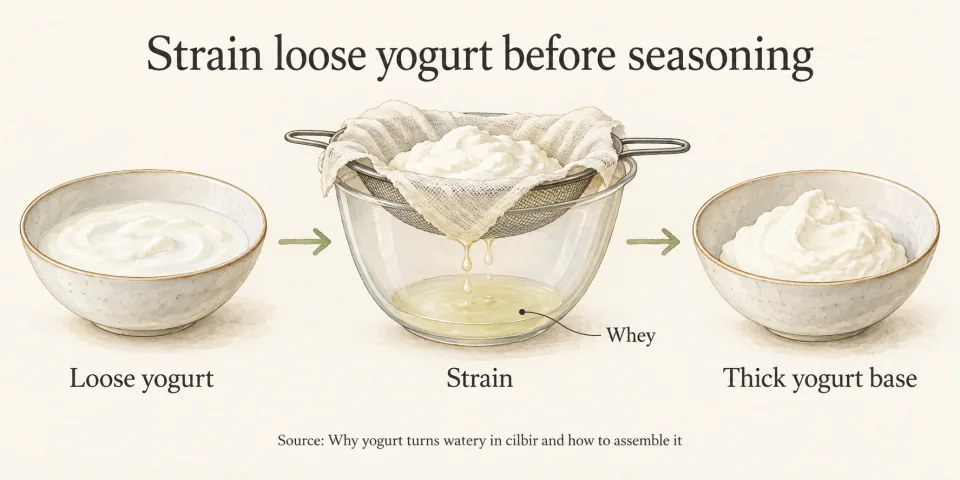
A lined sieve over a bowl provides a way to remove whey from loose yogurt. Harvard describes this arrangement for home straining, and Utah State University Extension identifies suitable fabrics for the job.
Set a fine-mesh sieve over a large bowl and line it with cheesecloth or a coffee filter, following Harvard's method. Utah State also describes a cotton bag, muslin or tightly woven cloth for removing excess whey. The cloth or filter holds the yogurt mass while liquid passes into the bowl beneath it.
Spoon the yogurt into the lined sieve and place the arrangement in the refrigerator while it drains, as Harvard directs. Refrigeration here belongs to the straining process. The bowl receives the separated whey, and the yogurt remains in the lining for the next preparation step.
Utah State explains that a longer period of straining produces thicker yogurt. Use the resulting consistency to judge the preparation: the purpose for this dish is to have a thick yogurt base ready before adding garlic and eggs. The draining stage can therefore come before the active poaching and topping work.
After straining, transfer the retained yogurt to a bowl for seasoning. Gordon's brief whisking with crushed garlic offers a sourced way to finish that component. This sequence gives each action a distinct purpose: the sieve removes whey, mixing distributes the garlic, and plating brings the yogurt together with the cooked eggs. None of those actions needs to be combined with heating the yogurt in a saucepan.
Part 05
of 09
05 / Field note
For homemade yogurt, review the setting stage
Excessive whey separation in homemade yogurt can begin during incubation, before cilbir preparation starts. University of Alaska Fairbanks identifies overlong incubation and agitation during setting as possible causes.
If homemade yogurt already has substantial separated whey before garlic is added, review the yogurt-making process alongside the dish preparation. The Alaska guidance concerns what happens while yogurt is setting. Its point about agitation should be read in that context, rather than applied to every later movement of a spoon through finished yogurt.
That distinction matters because Gordon's cilbir recipe does briefly whisk finished yogurt with garlic. Mixing a completed yogurt component and disturbing yogurt during its setting stage are different operations. Follow the yogurt-making instructions for incubation, then use the cilbir recipe for seasoning and assembly.
The sources also describe separate ways that preparation affects water retention. Wisconsin explains the role of heating milk before fermentation; Alaska discusses incubation and movement during setting; straining sources describe removing whey after fermentation. These steps occur at different points in making the ingredient.
For the current dish, strained yogurt remains a preparation option. For a later batch of homemade yogurt, reviewing the incubation stage addresses a different question: why the yogurt released so much whey before it reached the cilbir bowl. Recording when separation first appeared makes that review more specific.
Part 06
of 09
06 / Field note
Separate egg straining from egg draining
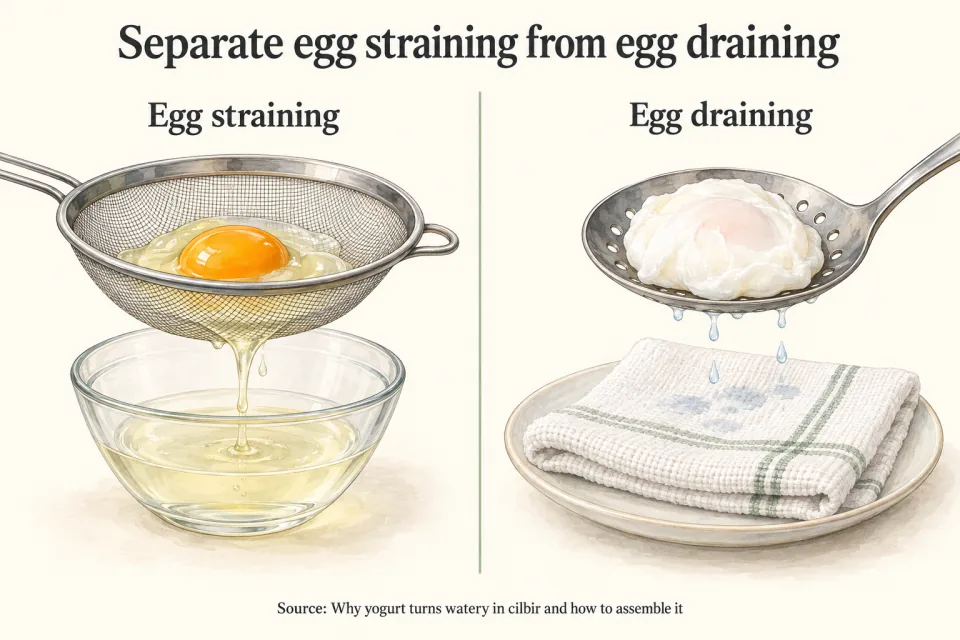
Straining an uncooked egg removes loose white; draining a poached egg removes water after cooking. Cilbir instructions may include both actions, but they belong at different stages and have different purposes.
Türkiye Today's recipe passes each uncooked egg through a fine-mesh sieve to remove loose white and improve the finished appearance. This happens before the egg enters the poaching water. For this step, the sieve is working on the egg itself, rather than separating water from a cooked egg.
After poaching, Türkiye Today's method briefly rests the cooked eggs on paper towel. The American Egg Board also describes draining cooked eggs, either in a slotted spoon or on paper towels. Include this step even when the uncooked eggs have already passed through a sieve.
For the poaching itself, the American Egg Board recommends gently simmering water without stirring or swirling. Its transfer method brings the egg's cup or saucer close to the water surface before releasing the egg. It also notes that very fresh eggs hold their shape better and produce fewer wispy threads during poaching.
The Turkish ministry uses a saucer for transferring each egg and cooks below simmering point. These are distinct published approaches to gentle poaching. Follow the chosen method through cooking, then give the draining step its own attention rather than moving straight from the pan to the yogurt.
A saucepan and slotted spoon are sufficient equipment for the American Egg Board's basic method. Lift the cooked egg with the spoon, then drain it in the spoon or on paper towel. Once that is done, proceed to the yogurt and pepper topping. This order makes the transition from water to plate explicit.
Part 07
of 09
07 / Field note
Use the recipe's temperature sequence
Peter Gordon's recipe prepares the yogurt at room temperature, uses warmed serving bowls and finishes with prompt assembly. It provides a temperature sequence to follow without putting the finished yogurt over direct heat.
Gordon briefly whisks thick Greek yogurt with crushed garlic during preparation. He then uses warmed bowls, with most of the yogurt beneath the eggs and the remaining yogurt over them. The warm bowl is part of his serving method; it is separate from cooking the yogurt in a pan.
University of Maine Extension's caution about yogurt's heat stability concerns its use in cooked recipes. Heating finished yogurt directly is therefore a different choice from following Gordon's room-temperature preparation. The milk-heating step described in yogurt-making science also occurs before fermentation, so it should not be read as an instruction to heat the completed garlic yogurt.
The pepper topping has its own heat sequence. Gordon browns butter, takes the pan off the heat and then adds chilli flakes. In the Turkish ministry's version, red pepper is stirred into heated olive oil. Türkiye Today describes gently warming olive oil and pepper flakes for its topping.
Choose the topping method that belongs to the recipe being followed. For Gordon's butter version, add the chilli after the pan leaves the heat; for the oil version, follow its gentle warming method. Bring the prepared topping to the assembled yogurt and drained eggs, then serve immediately, as Gordon directs.
Part 08
of 09
08 / Field note
Assemble with each component ready
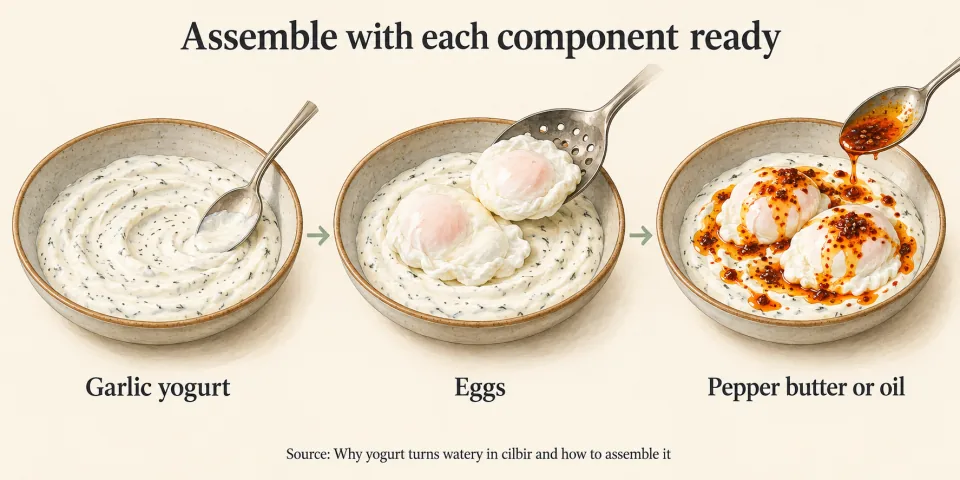
Prepare the garlic yogurt and pepper topping so the drained eggs can go directly into the chosen assembly sequence. The published cilbir methods differ in layering, but both give draining a place before the eggs meet the yogurt.
For the Turkish ministry's version, put the drained poached eggs on the plate first. Pour the crushed-garlic yogurt over the eggs, then finish with the red pepper stirred into heated olive oil. The yogurt goes over the eggs in this method, rather than forming a complete base beneath them.
For Gordon's version, use warmed bowls and spread most of the garlic yogurt into them. Add the eggs, put the remaining yogurt over the top and finish with the prepared pepper butter. His recipe calls for immediate serving. Follow that sequence as a complete method when using his combination of thick yogurt, warmed bowls and butter.
As a practical preparation example, resolve a loose yogurt base before starting the final assembly. Strain it using the lined-sieve method, mix in the garlic, prepare the topping, and then complete the poaching and draining steps. This combines the sourced yogurt preparation with the component order of the cilbir recipes; it is a cooking sequence, not a reported kitchen test.
For a batch made with already-thick yogurt, begin with garlic mixing instead. The egg preparation still includes draining after poaching. Separating those tasks on the work surface makes it possible to review the yogurt and the eggs independently, even though they end up together in the serving bowl.
Part 09
of 09
09 / Field note
Bread and the yogurt's protein concentration
Bread is an accompaniment for dipping into cilbir, while straining changes the concentration of the yogurt itself. These are separate parts of describing the breakfast: what goes alongside the dish and how its main ingredients were prepared.
Türkiye Today lists rustic bread, simit or crusty bread alongside its cilbir recipe. Bread for dipping can accompany either the yogurt-over-eggs arrangement or a bowl assembled with yogurt beneath and above the eggs. Describe the bread alongside the poached eggs, garlic yogurt and pepper topping when setting out the dish.
Wisconsin's concentration monograph explains that removing whey increases the protein and fat content of the retained yogurt. The same preparation step therefore changes more than its spoonable texture. Whey passes through the cloth, while the retained yogurt becomes more concentrated.
That is a qualitative description of straining, rather than a fixed nutrient amount for homemade strained yogurt. In a cooking note, identify the yogurt as strained or unstrained and describe the bread used alongside it. For the watery-yogurt problem, the useful preparation details remain concrete: the yogurt's condition before seasoning, the method used to drain the cooked eggs and the assembly sequence followed at serving.
Sources / 10
- Yogurt Monograph Series: Production
- Making Yogurt at Home
- Yogurt Monograph Series: Concentrating Yogurt
- Homemade Fermented Yogurt
- Yogurt
- Poached Egg With Yogurt
- Turkish Eggs
- Cilbir: Türkiye’s savory poached egg breakfast comes together in 10 minutes
- Bulletin #4167, Altering Recipes for Better Health
- Basic Poached Eggs
Continue reading
Return to the card board