Field note
Lentils or black beans for breakfast patties: binders and pan cooking
Compare cooked lentils and black beans through published patty recipes, including egg and egg-free binders, moisture preparation, patty size and pan-cooking cues.
Part 01
of 10
01 / Field note
Choose the pulse with its recipe
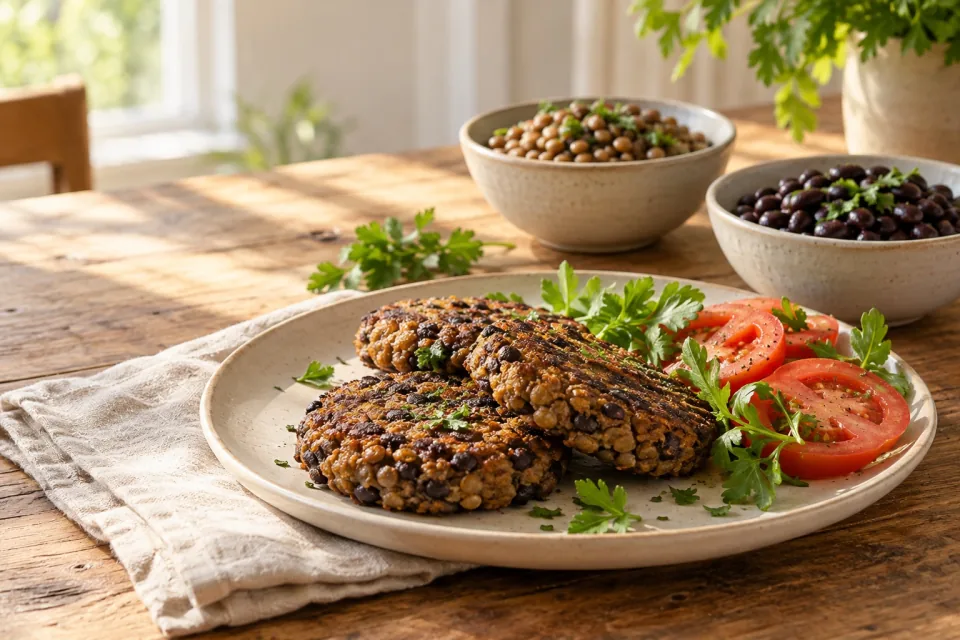
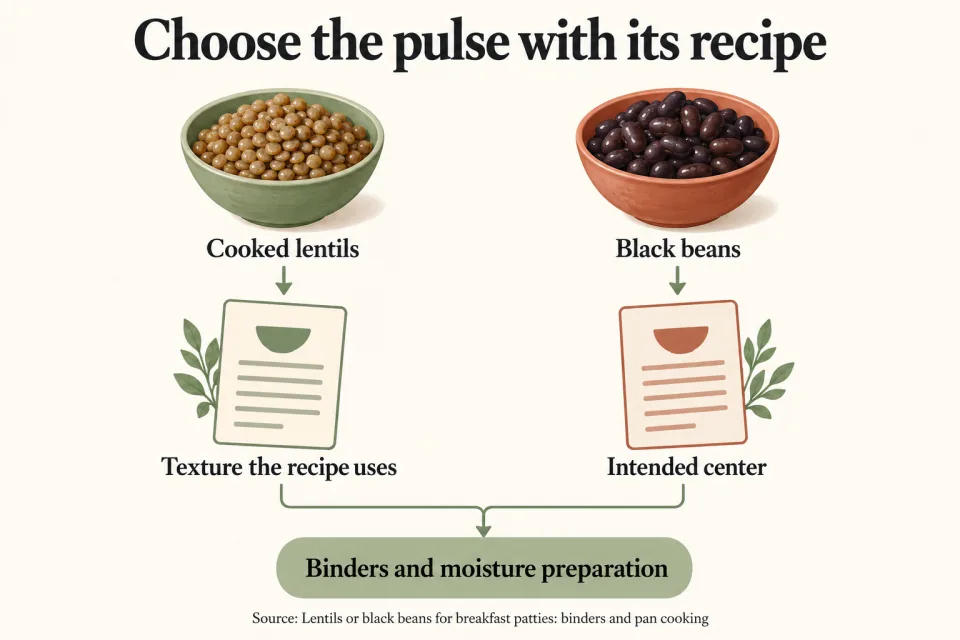
Lentils suit the small, spooned breakfast patties in Montana State University's recipe, while black beans suit the shaped burgers described by Purdue University Extension. The useful comparison starts with those complete methods: the cooked pulse, its binder and the way the mixture enters the pan.
Montana's lentil mixture contains cooked lentils, beaten egg and onion salt. Purdue's black bean mixture combines beans with egg, dry breadcrumbs and salsa. These are different preparations, so choosing between them also means choosing a different mixture and shaping method. For breakfast, start by deciding whether you want to spoon the mixture directly into the skillet or shape it beforehand.
There are egg-free routes for either pulse. The University of Michigan pairs green lentils and mushrooms with oat flour, while The Kitchn uses mashed ripe avocado and rolled oats with black beans. The YMCA of Greater Seattle takes another breakfast approach, combining lentils with oats, ground flaxseed and savory seasonings.
Read each as a recipe in its own right. An egg-bound lentil patty, a gram-flour lentil fritter and an avocado-bound black bean burger offer distinct starting points. The sections below compare their documented preparation and cooking methods so that the choice follows the kind of patty you want to make.
Part 02
of 10
02 / Field note
Cook lentils for the texture the recipe uses
Lentil variety and cooking texture matter when choosing a patty recipe. Montana State's lentil guide describes red and golden lentils as varieties that cook quickly and lose their shape. Pardina and French green lentils retain their shape after cooking.
Those differences appear in the published methods. Michigan cooks green lentils until firm, then cools them thoroughly before mixing its burgers. Good Food's fritters begin with a prepared red split lentil dish. Choose the lentil preparation named in the recipe, including whether it calls for firm lentils or a soft, seasoned base.
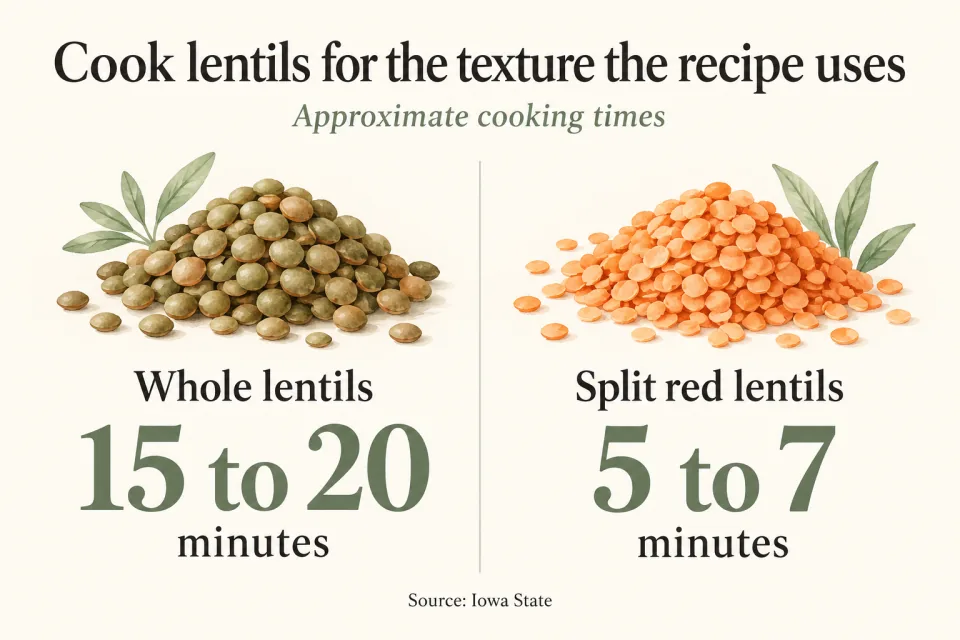
For cooking dry lentils, Iowa State University Extension advises sorting out stones, dirt and withered seeds, then rinsing under cool running water. Its guide says lentils can be cooked without soaking. Iowa State uses one cup of lentils with three cups of water, bringing them to a boil before simmering under a lid.
Iowa State gives approximate cooking times of 15–20 minutes for whole lentils and 5–7 minutes for split red lentils. Older dry lentils may take longer to soften, according to the same guide. Montana State also explains that cooking time varies with the lentil variety and the intended texture, with a purée needing longer cooking than lentils for a salad.
Canned lentils are an option in Montana's small-patty recipe. That method calls for thoroughly rinsing and draining them before mixing. It provides a direct route to that particular egg-bound preparation without adding a separate lentil-cooking stage.
Part 03
of 10
03 / Field note
Prepare black beans for the intended center
Black bean recipes handle moisture in different ways, from simple draining to an oven-drying stage. Purdue begins with drained, rinsed canned beans. Serious Eats dries cooked beans in the oven and reports a denser burger interior with less mushiness.
The University of Maine describes black beans, also called turtle beans, as sweet-tasting with a soft texture. For soaked beans, its preparation guide calls for a gentle simmer to help the skins remain intact. It advises draining the beans as soon as they reach the desired texture, stopping further cooking.
The Kitchn gives a more specific drying method: heat the drained beans at 350°F for 10–12 minutes, until their surfaces feel dry and they begin to split, then cool them. That preparation belongs to its avocado-and-oat burger recipe. Follow the drying stage together with the rest of that method, including its binder and shaping instructions.
For a cook comparing recipes, the distinction is useful. Purdue's method starts from drained and rinsed beans, while The Kitchn adds an oven stage before mixing. Serious Eats links its drying step to the texture of the center. Decide which preparation you want to follow before choosing the binder, so the bean preparation and the remaining instructions come from the same recipe.
This also gives a concrete way to read descriptions of black bean patties. Look for what happens to the cooked beans before they are mashed: draining, drying and cooling are separate actions in these published methods.
Part 04
of 10
04 / Field note
Compare egg binders within their full mixtures
The egg-bound lentil and black bean recipes use different amounts of pulse and different supporting ingredients. Montana State combines one cup of cooked lentils with one beaten egg and onion salt. Its base contains neither flour nor breadcrumbs.
Montana drops the mixture into an oiled frying pan by tablespoonfuls and flattens it there. Cornmeal or breadcrumbs are offered as an optional coating on the outside. That distinction matters when reading the recipe: an exterior coating is a different instruction from mixing crumbs through the lentils. Follow whichever version of the coating instruction you choose while retaining the recipe's base.
The University of Maine combines one and a half cups of cooked black beans with one beaten egg and half a cup of breadcrumbs to make four patties. Purdue's four-patty recipe uses one drained and rinsed 15-ounce can of black beans, one egg and half a cup of dry breadcrumbs. These formulas describe shaped black bean burgers with crumbs in the mixture.
Purdue also limits the salsa added during mixing. Only one-third cup of its salsa goes into the patty mixture; the rest is for serving. Measure that addition as part of the recipe rather than emptying all the serving salsa into the bowl.
For breakfast, the practical choice is between Montana's spoon-and-flatten lentil method and the shaped black bean methods. The published quantities belong to those specific preparations. Use the pulse quantity, egg, crumbs where called for, and shaping instructions together when selecting a recipe.
Part 05
of 10
05 / Field note
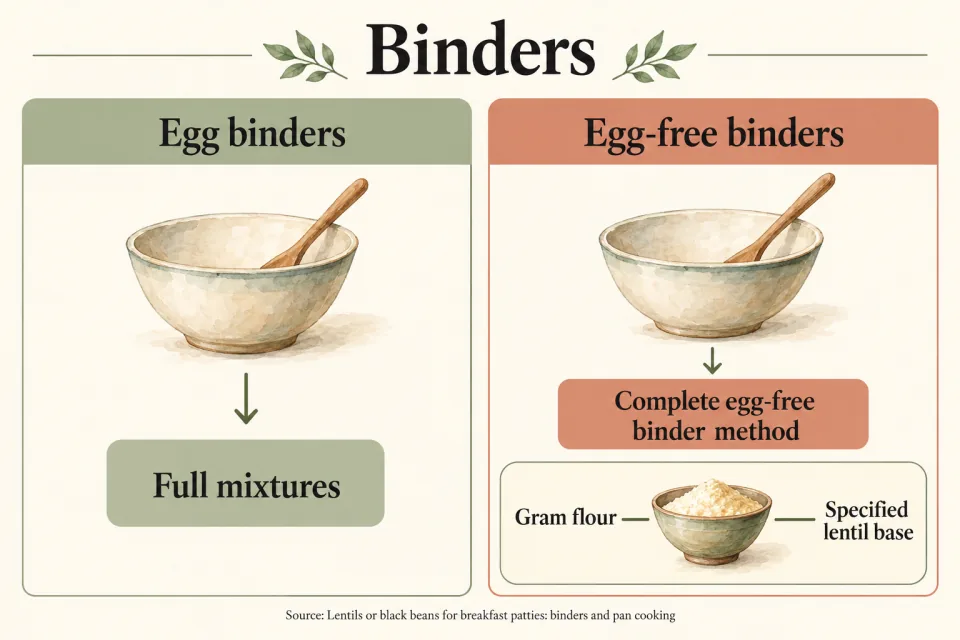
Follow a complete egg-free binder method
Egg-free patties have several documented binder combinations, with distinct preparation steps. Michigan's lentil-and-mushroom recipe uses a quarter cup of oat flour for six patties and lists no egg. Miso, garlic and smoked paprika season the mixture.
Michigan suggests processing one-third cup of rolled oats to make the quarter cup of oat flour used in its recipe. The lentils are only partly mashed, leaving some whole in the mixture. Processing half the lentils is offered as an alternative to mashing. This method combines a partly mashed pulse base with measured oat flour, rather than turning all the lentils into a smooth paste.
The Kitchn uses mashed ripe avocado as the binder in a black bean mixture that also contains rolled oats. Its recipe pairs that mixture with the bean-drying stage described earlier. For an avocado-bound black bean patty, follow that sequence through from drying to cooling, mixing and shaping.
The YMCA breakfast patties combine lentils, rolled oats and ground flaxseed. Its consistency instructions are specific: add water to a dry mixture or oats to a wet mixture, a tablespoon at a time. Those adjustments are part of the YMCA method and offer a measured way to make its stated corrections.
Choose among these recipes by the ingredients and preparation you want to use. Oat flour with green lentils and mushrooms, avocado with black beans and rolled oats, and the YMCA's lentil-oat-flaxseed mixture are separate egg-free options. Each comes with its own approach to the cooked pulse and the finished mixture.
Part 06
of 10
06 / Field note
Use gram flour with the specified lentil base
Good Food's lentil fritters use a seasoned red-lentil preparation as their starting point. Good Food Middle East mixes that prepared lentil dish with gram flour to make its fritter base. Chopped coriander and spring onion go into the fritter mixture before it is set aside.
The linked base contains red split lentils, onions, garlic, ginger, tomatoes and turmeric. Good Food simmers this preparation for 25–30 minutes after adding water, until the lentils are tender. Coriander, cumin and black mustard seeds are fried separately, then stirred through with lemon juice.
That ingredient list is part of understanding the fritter formula. The measured lentil base already includes vegetables, seasonings and the separately cooked spices. Read the linked preparation alongside the fritter recipe so the ingredient called for in the mixing bowl is the prepared dish the publisher specifies.
The fritter mixture is divided into four portions in the frying pan, flattened and cooked until golden on each side. Good Food Middle East pairs the fritters with carrot and courgette ribbons dressed with lime and sesame oil. This gives the dish a different serving direction from the herb-seasoned breakfast patties described by the YMCA.
Choose this route when you want to begin with the seasoned red-lentil dish and carry its flavors into the patties. The gram flour quantity, chopped herbs and spooned shaping method belong together in that preparation. Montana's plain cooked-lentil and egg recipe is a separate option for a simpler base.
Part 07
of 10
07 / Field note
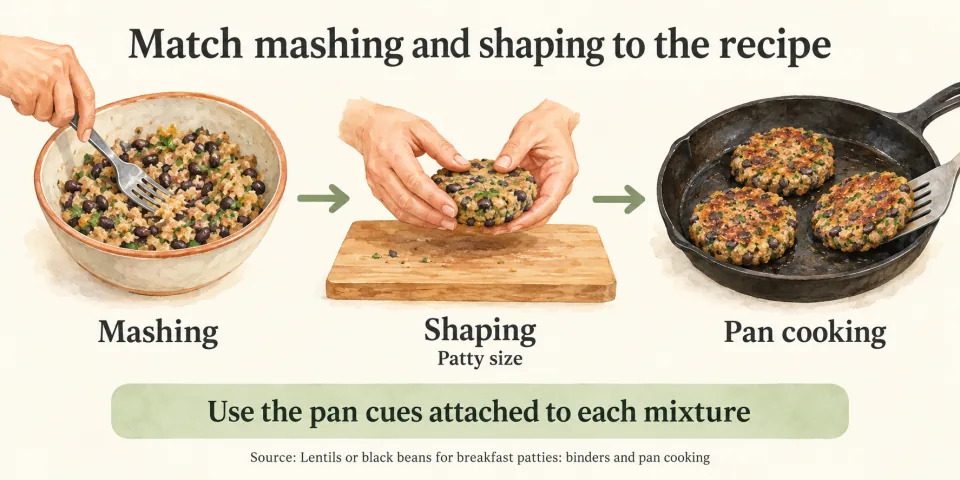
Match mashing and shaping to the recipe
Partial mashing is used in both lentil and black bean recipes. Michigan leaves some lentils whole while mashing the remainder. Purdue mashes approximately half its black beans before adding the remaining beans and breadcrumbs.
These methods give the cook clear instructions about how much of the pulse to work into the mixture. Follow the recipe's split between mashed and whole pulses as you mix. Montana State's lentil guide describes another approach, blending cooked lentils with olive oil and optional seasonings into a smooth base for patties or croquettes.
Shaping also differs between the recipes. Montana spoons its lentil mixture straight into the frying pan and flattens it there. The YMCA portions its breakfast mixture in two-tablespoon scoops and presses each scoop into a patty with a fork in the skillet. Both give a documented route to making small patties directly in the pan.
Michigan shapes its lentil burgers before pan cooking. It recommends using two spatulas to move the shaped patties into the pan without breaking them. That handling instruction is useful when choosing this method: arrange the utensils before transferring the shaped mixture.
Purdue forms black bean patties approximately three-quarters of an inch thick. Use that dimension with Purdue's mixture and cooking method. When reading another recipe, check whether it specifies spooned portions, a scoop size or a thickness, then follow that recipe's shaping instruction through to the pan.
Part 08
of 10
08 / Field note
Use the pan cues attached to each mixture
Pan heat and turning instructions vary across these recipes. Montana cooks its flattened lentil patties on both sides over medium heat in an oiled frying pan. Michigan also uses medium heat, with a more specific description of the surface it wants.
Michigan cooks its lentil patties for about three minutes per side, aiming for golden surfaces and crisp edges. That instruction belongs to its green-lentil, mushroom and oat-flour mixture. Use the stated heat, time and appearance together when following that recipe.
Purdue cooks its black bean patties uncovered in an oiled nonstick skillet over medium-high heat until lightly browned. The recipe calls for turning them once. The Kitchn cooks its black bean patties over medium-high heat for three to four minutes per side, aiming for a dark, crisp crust.
Serious Eats recommends moderate skillet heat so the outside does not blacken before the egg-containing center cooks. Its author also reports that skillet cooking gave a deeper, more evenly crisped crust than grilling. These are observations from that recipe's development, so attribute the reported result to that method when comparing it with the others.
For its egg-containing black bean patties, the University of Maine specifies checking the center with a food thermometer for 160°F. Follow that temperature check when making the Maine recipe. Its published method combines baking with skillet cooking, which is another reason to read the full cooking sequence rather than selecting only the pan stage.
Part 09
of 10
09 / Field note
Compare patty size before comparing equal counts
An equal count of patties can represent different portions of the same mixture. The Kitchn explicitly allows its black bean mixture to make either four larger patties or six smaller patties. That choice changes the size of each patty while retaining the recipe's mixture.
The other recipes describe size in different ways. Montana uses tablespoonfuls, while Purdue specifies a thickness for shaped burgers. A spooned lentil patty and a shaped black bean burger therefore need to be read with their own portioning instructions. The word patty alone does not describe their dimensions.
For a useful comparison on the page, read the batch ingredients beside the yield and shaping instructions. Maine's black bean formula states a cooked-bean volume and a finished count. Purdue identifies a can size, a finished count and a patty thickness. Montana describes how to spoon the mixture into the pan. Each provides different information about the finished food.
Keep the recipe name attached to the result you are comparing. Michigan's golden-edged lentil burgers and The Kitchn's dark-crusted black bean burgers describe particular mixtures and pan methods. Comparing those complete recipes answers a practical breakfast question: which preparation and finished style would you like to make?
An ingredient comparison asks a narrower question about lentils and black beans themselves. For cooking decisions here, the documented recipes are more useful when their pulse preparation, binder, shaping and pan instructions remain together. Choose the finished style first, then follow the recipe that describes it.
Part 10
of 10
10 / Field note
Choose a breakfast seasoning and serving style
The YMCA's lentil patties offer a directly documented breakfast seasoning pattern. Sage, thyme, smoked paprika, cloves, onion powder and garlic powder season its lentil, oat and ground-flaxseed mixture. The publisher categorizes the dish as a vegan breakfast recipe.
Michigan takes its lentil burgers in a different direction with miso, garlic and smoked paprika alongside mushrooms. For a black bean option, Purdue offers cumin or chili powder as alternative seasonings. Choose the recipe whose seasoning appeals to you, then use the pulse and binder combination attached to it.
Good Food's fritters carry the ginger, tomatoes, turmeric and other spices of their prepared red-lentil base. Their carrot and courgette ribbons with lime and sesame oil give a published serving option. Purdue supplies another straightforward serving detail by putting some salsa in the patties and using the remainder alongside them.
The choice can now be specific. Montana provides a small lentil-and-egg patty spooned directly into the pan. Michigan provides a shaped, egg-free lentil-and-mushroom burger. Purdue provides a black bean, egg and breadcrumb burger with salsa, while The Kitchn provides the avocado-and-oat route.
Start with the method that fits the breakfast you want to cook. Read its pulse preparation before mixing, portion it as directed and use its own pan cues. That keeps the choice grounded in a published dish, from the cooked lentils or beans through to the finished patty.
Sources / 11
Continue reading
Return to the card board