Field note
Vegetarian breakfast menus with idli, dosa, adai and pesarattu
Build breakfast combinations from measured rice-and-dal recipes, with sambar, peanut chutney, curd-based avial and cowpea sundal. Compare the ingredients, batter methods and preparation schedules.
Part 01
of 10
01 / Field note
Build the menu around the batter and its accompaniments
Start a vegetarian breakfast menu with the measured rice and pulses in the main dish, then choose its accompaniments. Idli, dosa, adai and pesarattu offer different starting points: their published recipes use different pulses, different proportions and different batter methods. An ingredient-based comparison gives the menu more detail than the dish name alone.
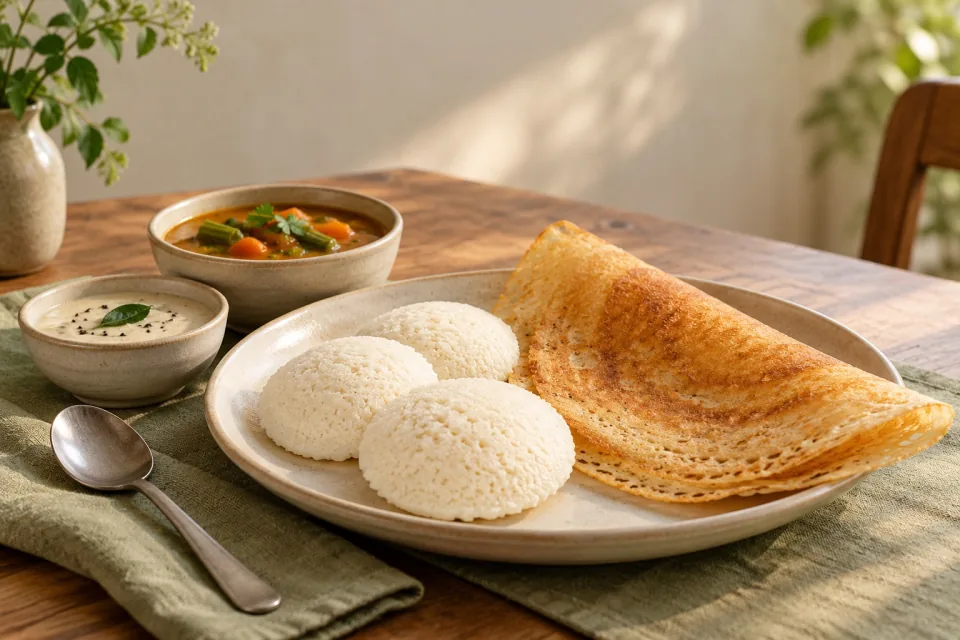
For a steamed breakfast, choose idli with toor-dal sambar and peanut chutney. The idli contains rice and black gram; the sambar adds a separate dal preparation with vegetables. The chutney brings peanuts together with chana dal and urad dal, so its ingredients deserve attention alongside the batter.
For a pan-cooked breakfast, dosa can take the same accompaniments. Adai with avial combines a mixed-dal pancake with vegetables, coconut and curd. Pesarattu offers a green-moong batter, with tomato chutney or ginger pickle among the published serving suggestions.
Use the measurements below as recipe references when choosing among these menus. Batch quantities describe what goes into a preparation; they are not protein amounts or instructions about how much anyone should eat. Choose the combination by its ingredients and the cooking work involved, then follow the relevant recipe method.
Part 02
of 10
02 / Field note
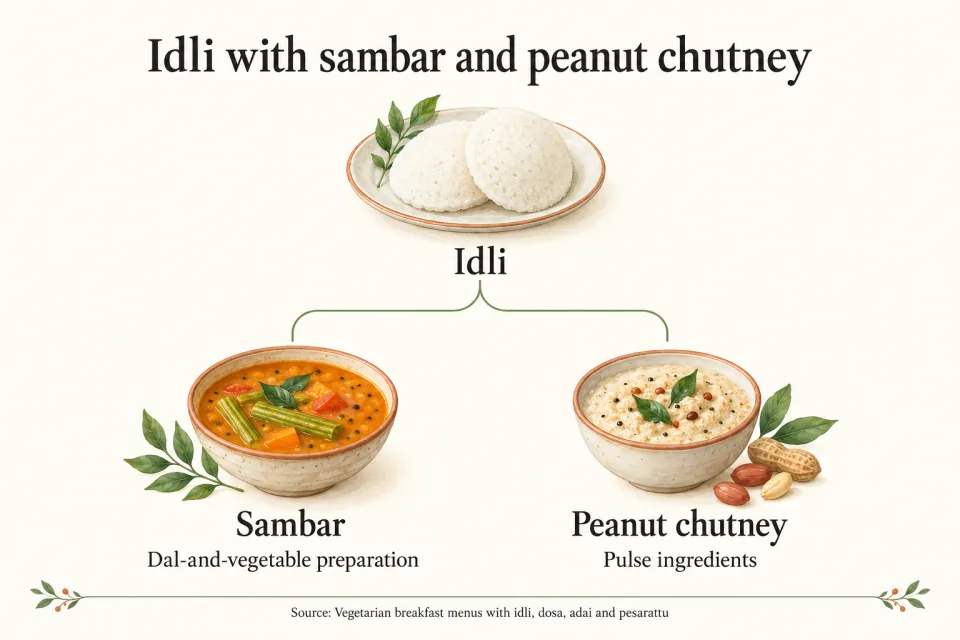
Idli with sambar and peanut chutney
Idli is a steamed cake made from fermented rice-and-black-gram batter, with fenugreek seeds included in the recipe. Its preparation centres on separate soaking and grinding, followed by fermentation and steaming. Sambar can be poured over the finished idli, with peanut chutney alongside.
The Raks Kitchen recipe card uses three cups of idli rice, half a cup of urad dal and one teaspoon of fenugreek seeds, with a stated yield of 30 idlis. Use that recipe-card formulation as the reference for this menu. It identifies the rice and dal going into the batch, while the stated yield describes the number of cakes the recipe makes.
In this method, the rice soaks separately from the urad dal and fenugreek seeds for three hours. The author grinds the urad dal on its own, adding cold water until the batter is light and aerated. Treat the separate grinding as part of this recipe's method when organising the preparation.
Raks Kitchen advises leaving the fermented idli batter unstirred before steaming to preserve its aeration. The sambar and chutney can be prepared as separate parts of the menu, with their own ingredient measures. Describe this breakfast as rice-and-urad idli, toor-dal sambar and peanut chutney: that names the contents more clearly than calling it simply an idli breakfast.
Part 03
of 10
03 / Field note
Dosa with a measured rice-and-dal batter
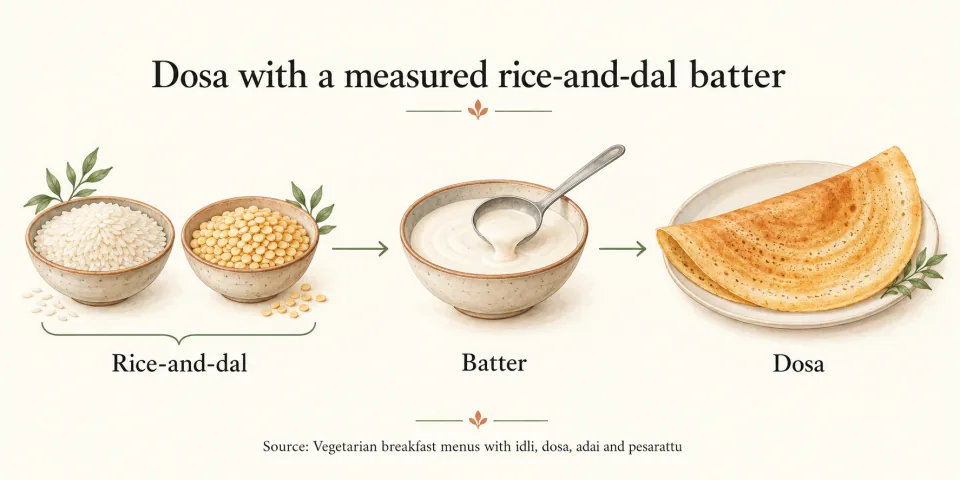
Dosa uses a pourable batter spread across a pan, and the rice-and-dal formulation matters when comparing menus. Good Food's recipe includes basmati rice, split urad lentils and chana dal. Pair it with the toor-dal sambar and peanut chutney described here, both of which have published dosa serving suggestions.
Good Food measures 190 grams of basmati rice, 50 grams of split urad lentils and one tablespoon of chana dal for its dosa batter. The recipe gives a yield of eight to ten dosas. Record the ingredient weights and the recipe yield as separate information when planning a batch.
The method calls for overnight soaking, then grinding and a further overnight fermentation period in a warm place. It describes the fermented batter as bubbly and doubled in volume. After fermentation, water is added to reach a thick, pourable consistency; this is the texture to establish before spreading the batter.
Use the bottom of a ladle to move the batter outwards from the centre in circles. Good Food lowers the pan temperature before beginning the next dosa. These pan steps distinguish the work of cooking dosa from steaming idli, even though Raks Kitchen also describes a fermented batter that can be used for either dish.
Choose the batter recipe before comparing the breakfasts. The Good Food formulation and the Raks Kitchen idli formulation are separate recipes, so attach each set of measures to its own menu.
Part 04
of 10
04 / Field note
Adai with mixed dals and vegetable avial
Adai combines rice with several dals in a coarse batter that can be cooked immediately after grinding. Raks Kitchen describes its version as a Thanjavur-style preparation from Tamil Nadu, India. Avial, a vegetable dish with coconut and curd, is a documented accompaniment.
The adai recipe uses one cup each of raw rice and parboiled rice, half a cup of chana dal, a quarter cup of toor dal and an eighth cup of urad dal. It also allows an optional eighth cup of moong dal. This formulation makes the individual dals visible, rather than grouping them under a vague instruction to use mixed lentils.
The rice and dals soak separately for three hours before being ground to a coarse texture. The author allows the batter to be cooked straight after grinding, while also permitting a resting period. Choose this menu when a batter that does not require a fermentation stage suits the cooking schedule.
Chopped onion, coriander and curry leaves go into the batter just before cooking. Spread the adai more thickly than dosa, then cook both sides until golden. A coarse batter and a thicker pancake are features of this method, so follow those cues instead of using the spreading technique for a fine dosa batter.
Drumstick leaves are another addition suggested for this same batter. For a menu comparison, distinguish a change to the adai itself from a change to its accompaniment: adding leaves changes the pancake, while choosing avial adds a separate vegetable-and-curd preparation to the meal.
Part 05
of 10
05 / Field note
Pesarattu with green moong and a chutney accompaniment
Pesarattu puts green moong at the centre of the batter, with a smaller measure of rice. Veganuary presents Saritha Sreedharan's recipe as an Andhra preparation from India. Its suggested accompaniments are tomato chutney and ginger pickle.
The recipe combines two cups of green moong dal with a quarter cup of rice, plus green chillies and ginger. Compared with the rice measures in the idli and dosa recipes, this is a different starting formulation. Compare the stated ingredients directly, without turning their cup measures into a claimed protein total.
The moong and rice soak for three hours before being ground with the seasonings into a fine batter. The published method then moves from grinding to cooking, without a fermentation stage. This makes its preparation sequence different from the Good Food dosa method, which includes fermentation after grinding.
Spread the batter across a tawa in the manner of a crepe and cook both sides over medium heat. The fine grind is also a distinction from the coarse texture specified for adai. Choose between these preparations partly by the batter and pan method you want to use, as well as by the pulses they contain.
For the finished menu, follow the suggested tomato chutney or ginger pickle pairing. The ginger and green chillies ground into the batter belong to the pesarattu recipe itself; the accompaniment is a separate choice.
Part 06
of 10
06 / Field note
Sambar adds a separate dal-and-vegetable preparation
Toor-dal sambar gives an idli or dosa menu a separate pulse preparation with vegetables and tamarind. The Raks Kitchen tiffin version lists potato, shallots and tomato. Its serving instructions include pouring sambar over idli and pairing it with dosa.
The recipe uses a heaped quarter cup of toor dal for four stated servings. That measure belongs to the whole sambar recipe. When describing the menu, record it with the sambar ingredients rather than attaching it to an unspecified bowl or ladleful.
Cook the toor dal and mash it smoothly before adding it to the tamarind-and-vegetable mixture. The author notes that the dal and ground sambar spices make the mixture thicker, with more water used to adjust the consistency. For a repeatable preparation, follow the same dal formulation and make the water adjustment as part of finishing the dish.
The vegetable suggestions include pumpkin, drumstick, brinjal, carrots, capsicum and radish. Choose from those documented alternatives when varying the accompaniment. A menu can therefore change its vegetables while still identifying the sambar as the toor-dal version.
Raks Kitchen also mentions a moong-dal tiffin sambar as another version. Name the dal when describing a breakfast combination, especially when comparing menus. “Idli with toor-dal sambar” gives a cook more useful information than “idli with sambar,” because it identifies the pulse preparation being served.
Part 07
of 10
07 / Field note
Peanut chutney has its own pulse ingredients
The peanut chutney in this menu contains peanuts, chana dal and urad dal, without coconut. Raks Kitchen suggests it with idli, dosa, paniyaram and upma. For the idli and dosa combinations here, it is a distinct accompaniment with its own measured ingredients.
The recipe uses half a cup of peanuts and one tablespoon each of chana dal and urad dal for four servings. Describe those measures as a chutney batch, separate from the quantities in the main batter. This also makes clear that the chana dal and urad dal are part of the chutney recipe, even though peanuts give it its name.
Dry-roast the peanuts over low heat, then cool and remove their skins before grinding. The roasted chutney ingredients are ground smooth with salt and water. Ginger is optional in the published recipe, so it can be included as a flavour choice without changing the basic description of the accompaniment.
Adjust the ground chutney with water, then finish it with a tempering of oil, mustard seeds, urad dal and curry leaves. The recipe also suggests shallot, sautéed tomato or garlic as alternative flavour additions. Choose a documented variation when changing the chutney, and name it clearly alongside the idli or dosa.
Part 08
of 10
08 / Field note
Curd belongs to the avial recipe
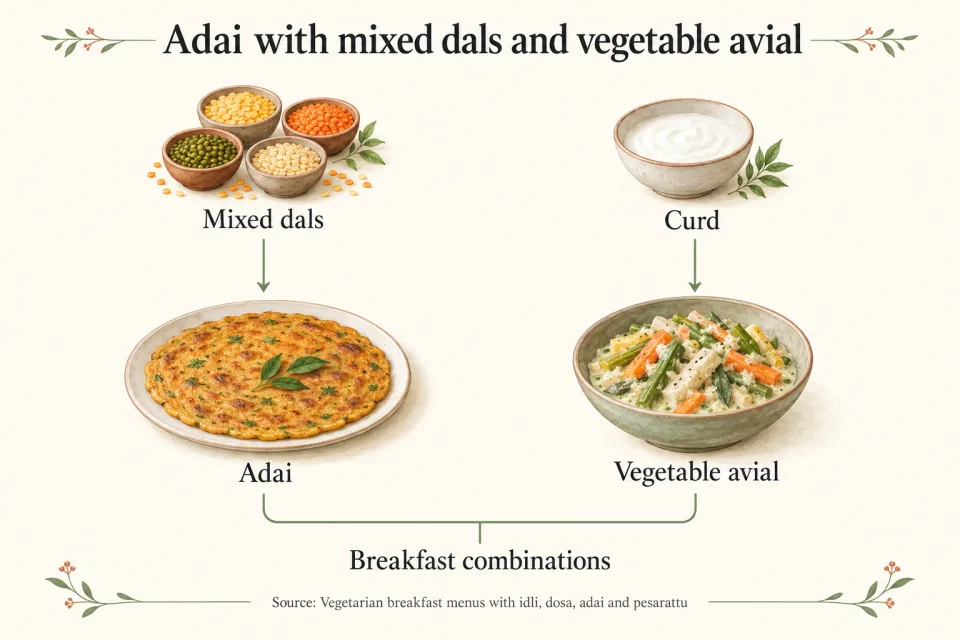
Avial brings mixed vegetables, coconut and curd to an adai menu. The Raks Kitchen page includes versions from Tamil Nadu and Kerala, India, and identifies adai with avial as a popular Tamil Nadu pairing. Coconut oil and curry leaves are also part of the preparation.
The Kerala-style instructions use three tablespoons of beaten curd in the vegetable mixture. In this formulation, the curd is an ingredient within the avial. Describe its contribution in that context when writing out the breakfast menu, alongside the vegetables and coconut.
The cooking sequence begins with vegetables that take longer to cook, followed by the softer vegetables. Follow that order when assembling the mixed vegetable dish. It gives the cook a practical sequence within the avial preparation, separate from grinding and cooking the adai.
The author recommends beating the curd smooth and adding it after the heat is switched off to avoid splitting. Plan the finishing step around that instruction. The curd is folded into the vegetable preparation at the end of this method.
For a vegan variation, the same page offers mango or tamarind in place of curd. Label that version by its chosen ingredient when comparing menus. The curd version and the mango or tamarind version are different formulations, even when both accompany the same adai recipe.
Part 09
of 10
09 / Field note
Cowpea sundal offers a whole-pulse preparation
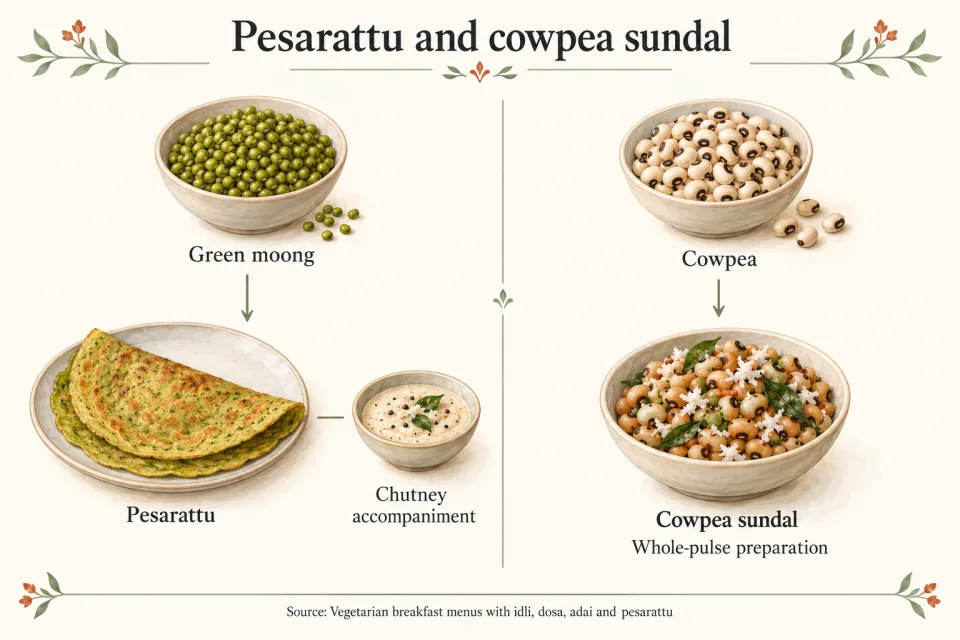
Cowpea sundal offers a separate way to prepare pulses without grinding them into batter. Veganuary's version combines cooked cowpeas with a tempering and grated coconut. It can be considered as another dish when planning a varied vegetarian breakfast menu.
The recipe starts with one cup of cowpeas and makes four servings. Its other ingredients include mustard seeds, urad dal, curry leaves and chillies, with grated coconut added at the finish. As with the batter recipes, the starting pulse measure describes the published batch.
The cowpeas soak for eight hours or overnight before pressure-cooking. Drain the cooked cowpeas before adding them to the tempering. The method then sautés them with the seasonings and finishes by mixing in the grated coconut.
Use this preparation as a comparison with the ground-pulse dishes: sundal involves soaking and pressure-cooking, while adai and pesarattu involve soaking, grinding and pan cooking. That difference is useful when choosing the work for a breakfast menu. Select the dish by the preparation you intend to make, and use its documented ingredients rather than treating all pulse dishes as the same recipe.
Part 10
of 10
10 / Field note
Choose the menu by its preparation sequence
Choose fermented idli or dosa when their batter preparation fits the schedule, and freshly ground adai or pesarattu when their methods fit better. The useful comparison is the sequence of soaking, grinding and cooking. Accompaniments add their own work, so include them when deciding on the menu.
For idli with sambar and peanut chutney, separate the jobs into batter preparation, steaming, dal-and-vegetable cooking, and roasting and grinding the chutney ingredients. For dosa with the same accompaniments, the pan work replaces steaming. Follow the chosen batter method throughout, including its texture instructions.
For adai with avial, organise the coarse batter and the mixed vegetable preparation as separate jobs. Add the chopped ingredients to the adai batter just before cooking, and finish the curd version of avial according to its heat-off method. Pesarattu follows a different route: fine grinding with ginger and chillies, then tawa cooking and the suggested accompaniment.
When comparing the finished menu descriptions, write the main dish, the named pulses and the accompaniments together. Include the published batch measures wherever precision is useful. This produces a concrete cooking plan: the reader can see which ingredients go into the batter, which belong to the side dishes, and which method each preparation follows.
Sources / 08
Continue reading
Return to the card board